- Chat Support
- FAQ
- Registrati
- Login
Standard UNI 11560:2022 defines the requirements for the installation, use, inspection and maintenance of permanent anchorage systems intended to protect against falls from height.
Periodic and extraordinary inspections are essential tools to ensure the long-term safety of the system and its suitability for the intended use.
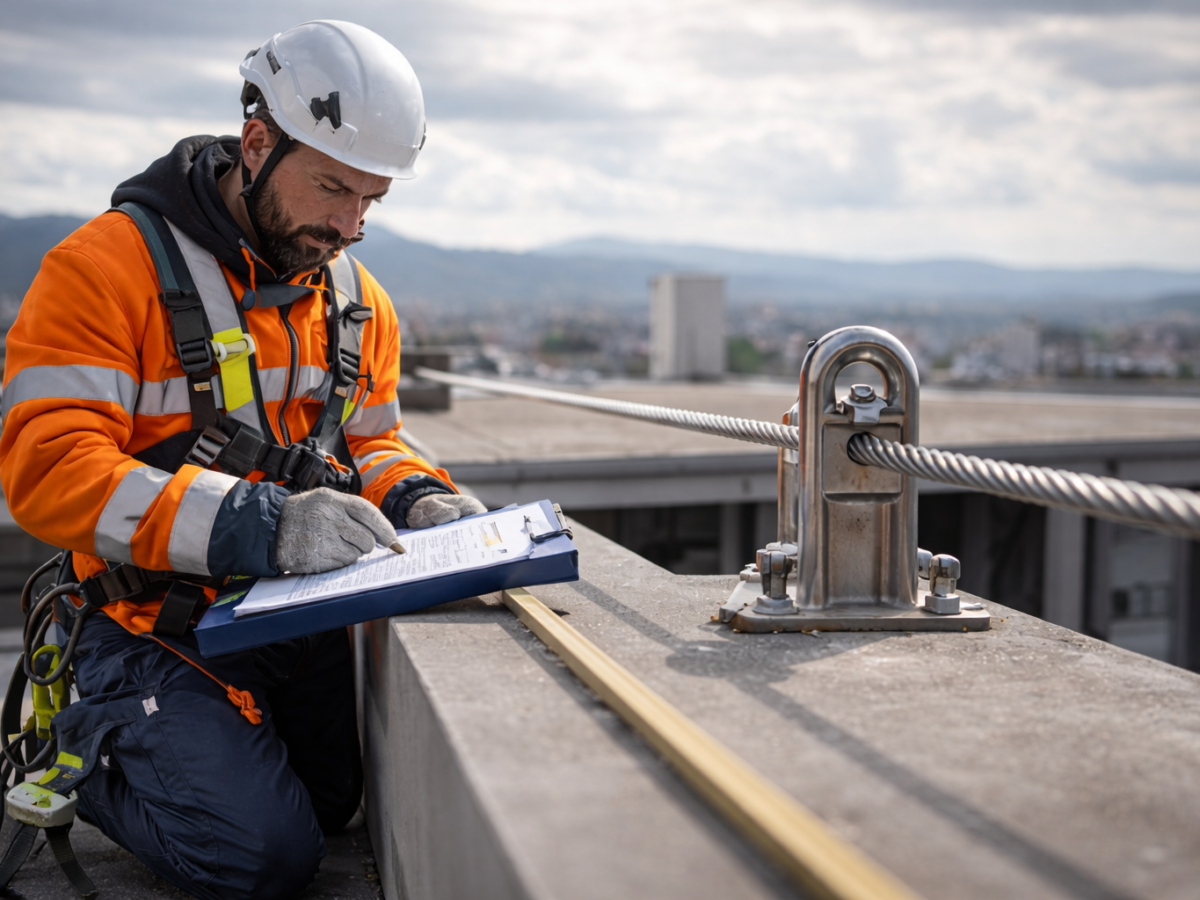
Inspections shall be carried out by a competent person, adequately trained and knowledgeable about the standard and the installed systems, and shall include:
The purpose of the periodic inspection is to verify that the anchorage system maintains its safety conditions over time.
The inspection frequency is established by the system manufacturer or, in the absence of specific instructions, at least once a year.
The periodic inspection allows to:
An extraordinary inspection shall be carried out whenever events occur that may compromise the efficiency or safety of the anchorage system, including, by way of example:
The extraordinary inspection may involve more in-depth checks than the periodic inspection and may require the use of instrumental testing.
| Checks | Periodic inspection | Extraordinary inspection |
|---|---|---|
| System layout drawing | O | O |
| General technical report | O | O |
| Structural calculation report | O | O |
| System photographic documentation | O | O |
| Declaration of correct system installation | O | O |
| Installation, use and maintenance manuals of the anchorage devices | O | O |
| Declaration of conformity/compliance of the anchorage devices | O | O |
| Indication of the PPE to be used | O | O |
| System maintenance programme | O | O |
| System inspection/maintenance logbook | O | O |
| System access log | O | O |
Document verification is essential to ensure system traceability, proper design, structural suitability, and the continuity of maintenance and inspection activities over time.
| Checks | Periodic inspection |
|---|---|
| Waterproofing | V |
| Wear | V |
| Oxidation / corrosion | V |
| Deformation of components | V |
| Abnormal deformation of the lifeline | S/F |
| Lifeline tensioning | S/F |
| Tightening of nuts and bolts of visible devices | V |
| Condition of any moving parts | F |
| Cleaning | V/F |
During periodic and extraordinary inspections, the system shall be intact, free from permanent deformations, significant corrosion or loosening of components, and shall ensure proper operation in accordance with the manufacturer’s specifications.
| Checks | Periodic inspection |
|---|---|
| Water infiltration | V |
| Anchorage elements | V / S |
| Cracks and/or corrosion and/or deterioration | V / S |
| Structural adequacy | V / S |
| Wood-boring insects, mould, etc. (timber structures) | V / S |
| Cleaning | V / F |
The supporting structure and anchorage elements shall ensure, over time, the mechanical performance defined at the design stage.
Any indication of structural degradation or loss of load-bearing capacity requires a detailed technical assessment and, where necessary, the suspension of system use.


