- Chat Support
- FAQ
- Registrati
- Login

Working at height on machinery involves risks far beyond normal ground-level activities. Understanding and preventing these hazards is crucial to ensure safety at height and protect operational continuity.
Slips or loss of balance on walkways, ladders, and platforms more than 2 m above a stable surface.
Countermeasures: rigid/flexible lifelines, guardrails, and certified harnesses.
Tools or components falling onto operators or damaging machinery below. Countermeasures: safety nets, tool containers, and lanyards.
Violent swinging of a tethered operator, with risk of hitting nearby structures. Countermeasures: overhead anchors and short lanyards.
After a fall arrest, the operator remains hanging with a risk of syncope. Countermeasures: rapid rescue procedures and retrieval devices (tripods, winches).
Wet surfaces or poorly placed cables increase fall risk. Countermeasures: anti-slip flooring, organized cable management, and signage.
Contact with live parts or nearby installations. Countermeasures: circuit breakers, grounding, and insulating PPE.
Gears and pulleys can trap hands or clothing. Countermeasures: physical barriers and lock-out/tag-out.
Lifting loads at height can cause injuries. Countermeasures: mechanical aids, ergonomic training, and balanced shifts.
Toxic gases or oxygen deficiency in adjacent confined spaces. Countermeasures: ATEX detectors, ventilation, and work permits.
An integrated approach — combining collective systems, PPE, and operational procedures — is the most effective strategy to reduce accidents in working at height on industrial machinery.

Compliance with the Machinery Directive 2006/42/EC and Legislative Decree 81/2008 to avoid penalties.

Calmer operators work more efficiently and with less stress.

Prevention is more economical than dealing with accidents and extraordinary repairs.
The Machinery Directive establishes that every machine must be designed to prevent major mechanical risks,
undergo a risk assessment, and be CE marked to demonstrate compliance with European safety requirements.
The Legislative Decree 81/2008, Title IV requires the employer to carry out a detailed risk assessment
for any intervention above 2 m, defining safe operating procedures and adopting certified fall protection systems.
The UNI EN 11578:2015 provides technical specifications for permanent lifelines, including resistance criteria,
durability, and on-site testing methods to ensure compliant installation.
The UNI EN 795:2012 completes the regulatory framework with requirements for mobile devices, essential for
temporary interventions, ensuring that every unit passes retention and braking tests in the event of a fall.
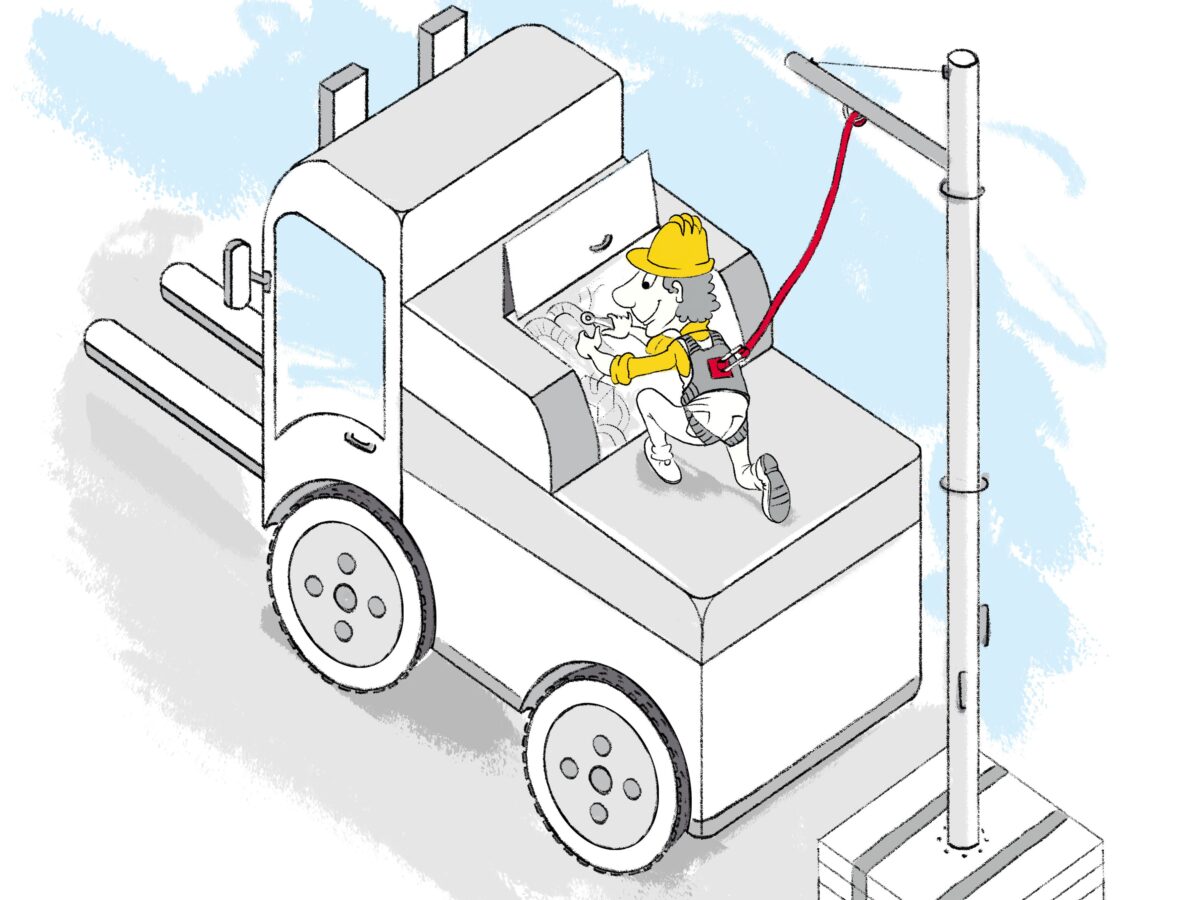
We install weighted systems on mobile platforms (MEWP, trolleys, lifts) to ensure solid anchoring without drilling the floor.
We connect limit switches and tension sensors directly to the PLC to stop the machine if the operator is not properly anchored.
Interventions on scaffolding and fall-protection ladders according to lock-out/tag-out procedures to ensure safety and operational continuity.
Full mastery and punctual application of European Directives (2006/42/EC, ATEX), UNI Standards (UNI EN 11578:2015), and EN Standards (EN 795:2012) are not just compliance obligations: they are strategic levers that reduce the probability of accidents by up to 40% and ensure constant operational continuity.
Addressing the challenges of working at height with a mix of technical expertise and advanced tools means creating a sophisticated work environment, increasing production line efficiency, and strengthening your business credibility with clients, partners, and investors.
We invite all stakeholders to consider safety as a true corporate asset.
Generally every 6–12 months, depending on manufacturer specifications and environmental conditions (elevated workstations, dust, salt exposure).
Certified weights are used to test the retention and deformation of anchoring points and weighted lifelines.
Machinery Directive 2006/42/EC and Legislative Decree 81/2008 (Title IV) – along with UNI EN 11578:2015 and UNI EN 795:2012 for anchoring devices.


