- Chat Support
- FAQ
- Registrati
- Login
How to ensure the safety of operators during routine and extraordinary maintenance operations on crane runway beams and overhead cranes?
In Italy, Legislative Decree no. 81 of 2008, known as the “Consolidated Law on Occupational Safety”, aims to establish uniform protection standards for workers across the country.
This applies to all sectors, including maintenance and access operations for overhead cranes and their runway beams in industrial facilities.
Runway beams represent a serious fall hazard for operators who need to intervene on malfunctioning cranes or even just pass along them. For this reason, adequate measures must be implemented to prevent and protect against falls from height, in accordance with current regulations.
SPIDER can provide you with tailor-made design, turnkey supply, installation, and maintenance of fall protection systems such as lifelines or fall arrest systems.
If you have all the necessary information and documents click here
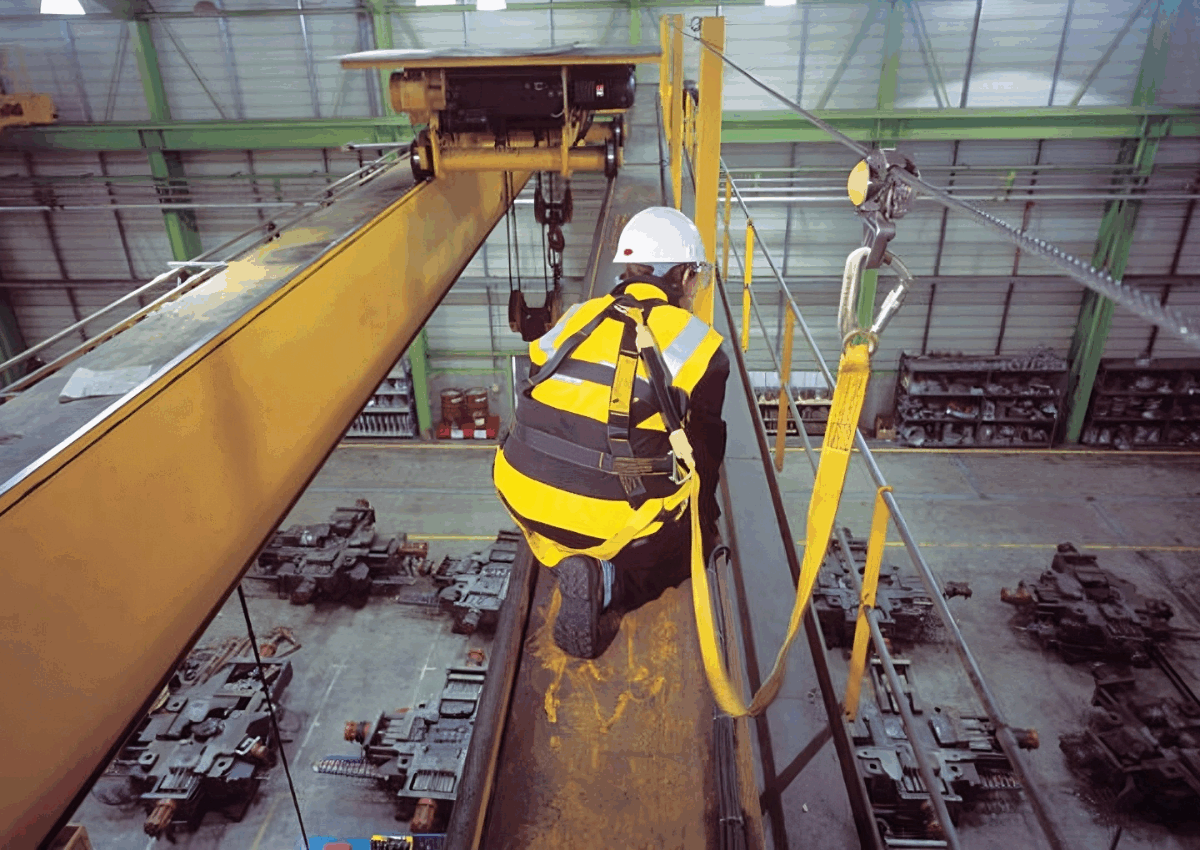
In the context of working at height, reliability and safety are fundamental.
For this reason, relying on industry specialists can be a huge advantage for your company.
When it comes to working at height, the technical complexity and associated risks are high. Regulatory requirements, risk management, staff training, selection, and maintenance of equipment are all aspects that require specific and up-to-date expertise.
By trusting specialists, you not only ensure compliance with current regulations but also benefit from the experience and technical skills these professionals bring. They can identify and mitigate risks, properly train your staff, and ensure equipment is always state-of-the-art and maintained in optimal conditions.
From a business perspective, investing in safety for work at height is not just a regulatory obligation but a strategic choice. A safe work environment can improve productivity, reduce costs related to accidents and occupational illnesses, and strengthen your company’s reputation.
In summary, choosing a turnkey solution provided by professionals specialized in working at height allows you to focus on your core business while a team of experts ensures a safe and compliant work environment. It is an investment that pays off in terms of peace of mind, efficiency, and corporate reputation.
Runway beams pose a significant fall hazard for operators. Being narrow and often in dark or dusty environments, it is mandatory to adopt prevention and protection measures against falls from height, in compliance with current regulations.
The main risks on crane runways are:
Pillar structure analysis: A technician must perform a thorough assessment of the pillars supporting the runway to determine the most suitable system and verify that the structure can withstand loads in case of a fall.
Design: A preliminary design must be drafted to evaluate the actual ergonomics of the lifeline and perform necessary assessments and corrections. If it is not possible to completely prevent fall scenarios, the clearance distance should be calculated. This parameter defines the minimum space required to prevent the operator from hitting the floor or other obstacles in case of a fall.
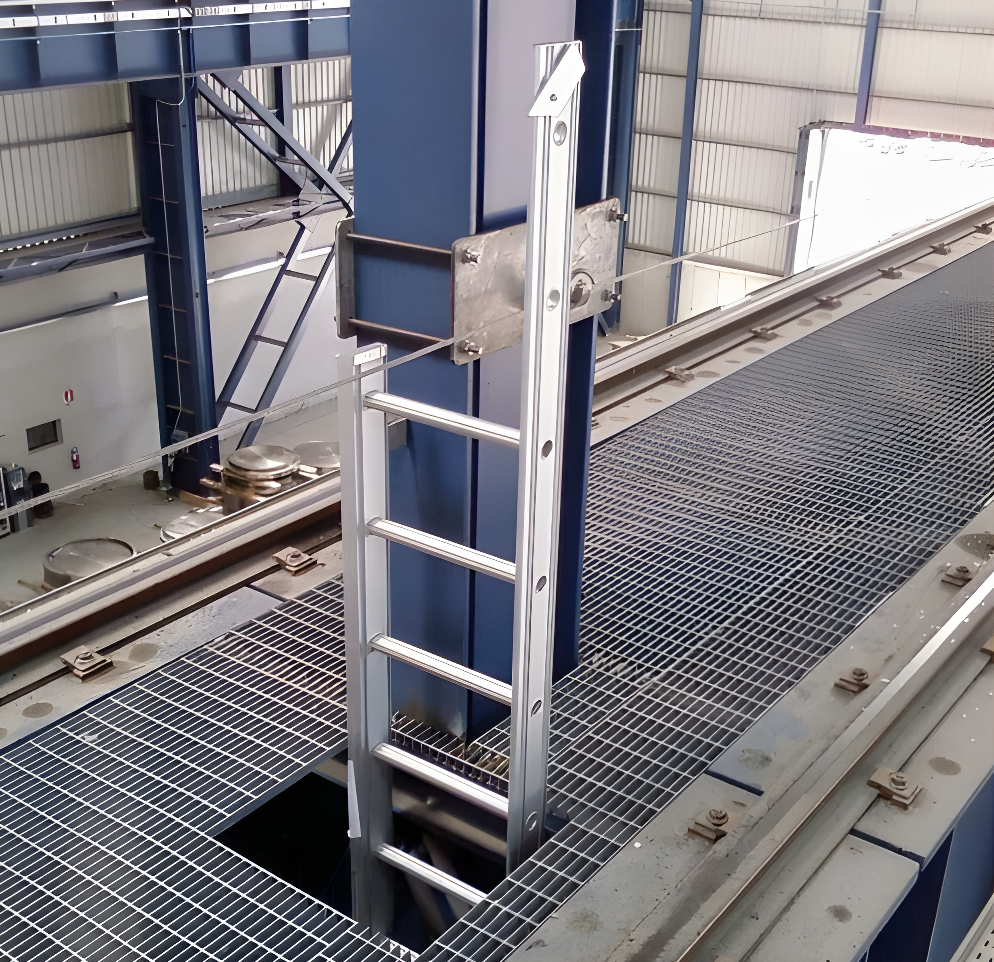
Accessibility: Verify safe access to the runway, either via a rope ladder or aerial work platform (AWP) suitable for boarding.
Surface inspection: To ensure operator safety, check not only the risk of falling outside the runway but also the presence of unprotected skylights, smoke vents, shafts, or any other hazards.
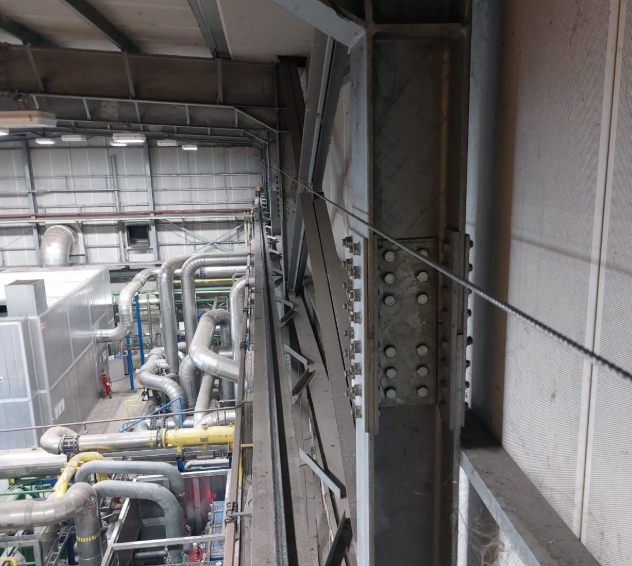
Horizontal flexible anchor lines, usually consisting of a cable stretched between two or more structural anchors, are the most common solution for crane runways. This setup allows the operator to move along an extended path without the possibility of detachment, thanks to a sliding shuttle between intermediate points. They can be rigid or deformable, depending on the need to limit fall forces on the structure.
During a site inspection at a large facility, one often notices overhead crane traffic.
For safety professionals, the obvious question arises: what if a malfunction occurs at such height? How can operators work safely?
Different scenarios arise depending on the type of malfunction and maintenance.
Some situations can be resolved by positioning an AWP and performing work directly from the basket. However, this is not always possible because it depends on where the crane stopped and whether there are obstacles for the AWP.
So how do we reach the area?
Simple, we use the crane runways as described above. Once we reach the area where the crane has stopped, the operator can transfer onto it, detach from the runway lifelines, attach to the lifelines installed directly on the crane (usually parallel to the walkway or at the trolley), and complete the work.
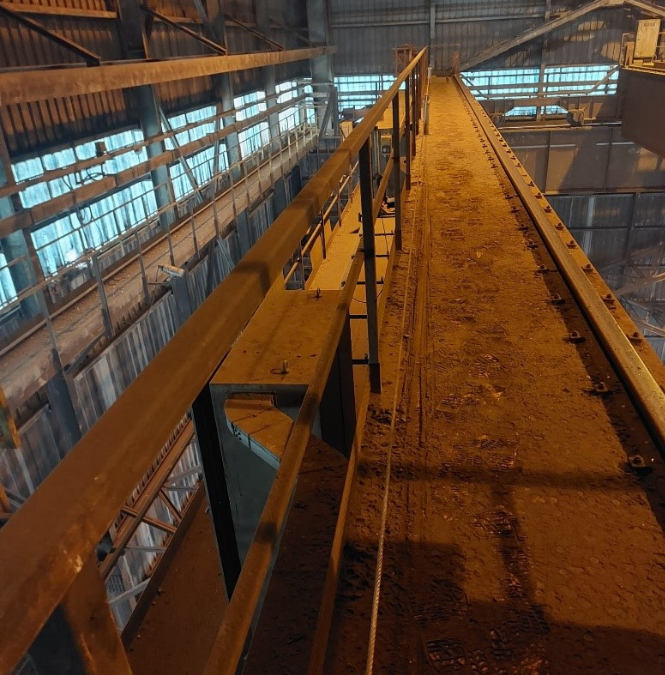
Access methods using lifelines are defined by strict regulations and safety procedures to ensure maximum worker protection. A correct approach relies on detailed planning and the use of appropriate equipment. It is essential to plan from the outset safe access to the structure, not only for system installation but also for future maintenance. This ensures that every intervention can be carried out safely and in full compliance with regulations.
SPIDERWIKI – Regulations in Italy and Europe for Working at HeightRegulations on working at height are crucial, especially in Italy and Europe, and include a series of rules designed to ensure worker safety. These regulations may seem complex, but we are here to help you understand them! First, it is important to emphasize that these rules were created with one goal in mind: your safety. These regulations cover requirements for training, safety equipment, and standard operating procedures. For example, specific training courses or the use of personal protective equipment (PPE) such as safety belts or harnesses may be required. How do these regulations apply in practice? And how can they affect your daily work? This is where our team of experts comes in. We are here to guide you through the maze of laws and rules so that you can work safely and in compliance. If you want to learn more or need assistance understanding how these regulations apply to your sector or situation, contact us. We can offer personalized advice, answer your questions, and guide you step by step. |
Working at height regulations – Italy
Legislative Decree 81/08 – Annex XXI
Regional Regulations on Safety Standards for Working at Height
Technical standards – Italy
UNI 11900:2023 – Non-regulated professional activities – Installer of anchoring systems – Knowledge, skills, autonomy, and responsibility requirements
UNI 11560:2022 – Permanent roof anchoring systems – Guide for identification, configuration, installation, use, and maintenance
UNI 11578:2015 – Anchoring devices for permanent installation – Requirements and test methods
UNI EN 795/2012 – Personal fall protection devices – Anchoring devices: fixed points, mobile fixed points, flexible linear, rigid linear, weighted anchors
Working at height regulations – Europe
Directive 2001/45/CE
Directive 89/656/CEE (use of personal protective equipment)
These EU directives are implemented by member states through national legislation. Regulations may vary from country to country within the EU, so it is important to check local laws.


It is the elevated path along which an overhead crane or hoist moves to transport loads.
The choice depends on factors such as load capacity, frequency of use, and architectural constraints. Spider conducts a free site inspection to recommend the optimal solution.
With regular maintenance, our systems guarantee excellent performance for over 10 years.


